The Uncalculated History of Mechanical Calculators.

My recent meet with the Pope jogged my memory about the existence of such forgotten gadgets as the arithmometer. The device being used may still be remembered by some in my generation, while to younger generations the ‘contraption’ is an antique – a relic from eons ago – when there was no Facebook (imagine?), and not even any Internet (WHAT?!).

But on this pre-digital analog bit of kit once the accounting of the whole world depended, and more besides. Therefore, this post is all about arithmometers, because history is worth knowing – especially when it’s as intriguingly quaint as this :).

What an invention! Of course, you could read all about it on Wikipedia, but here I’ll give you a summary of what are, IMHO, the highlights.

Mechanical calculators appeared… more than 2000 years ago! The ancient Greeks used them! What, didn’t you know? I kind of did, but – once again (eek!) – my memory later failed me. So I looked up the details to refreshen those synapses.

Aha – here she is, the beut! The Antikythera mechanism – originating one or two centuries BC; that is – 2100+ years ago!

The Antikythera mechanism is an ancient analog computer and orrery used to predict astronomical positions and eclipses for calendrical and astrological purposes, as well as the Olympiads, the cycles of the ancient Olympic Games.

Found housed in a 340 millimeters× 180 millimeters× 90 millimeter wooden box, the device is a complex clockwork mechanism composed of at least 30 meshing bronze gears. Its remains were found as one lump, later separated into three main fragments, which are now divided into 82 separate fragments after conservation works. Four of these fragments contain gears, while inscriptions are found on many others. The largest gear is approximately 140 millimeters in diameter and originally had 223 teeth. (Wikipedia)

Oh those Greeks!

Fast forward some 1600 years, and the next example of a mechanical calculator gets drawn by Leonardo da Vinci. That device was a 16-bit adding machine with 10-tooth cogs.

Another long pause – of 120 years…

Surviving notes from Wilhelm Schickard in 1623 report that he designed and had built the earliest of the modern attempts at mechanizing calculation. His machine was composed of two sets of technologies: first an abacus made of Napier’s bones, to simplify multiplications and divisions first described six years earlier in 1617, and for the mechanical part, it had a dialed pedometer to perform additions and subtractions.

Two decades later…

Blaise Pascal designed [a] calculator to help in the large amount of tedious arithmetic required; it was called Pascal’s Calculator or Pascaline. 

30 years later – the ‘stepped reckoner’… 

– A digital mechanical calculator [was] invented by the German mathematician Gottfried Wilhelm Leibniz. It was the first calculator that could perform all four arithmetic operations. Its intricate precision gearwork … was somewhat beyond the fabrication technology of the time.

And after that, a veritable arms calculator race ensued…

[In 1674 came] Samual Morland’s ‘arithmetical machine’ by which the four fundamental rules of arithmetic were readily worked “without charging the memory, disturbing the mind, or exposing the operations to any uncertainty” (regarded by some as the world’s first multiplying machine).

In 1709…

[Giovanni] Poleni was the first to build a calculator that used a pinwheel design.

And here come the warm jets real arithmometers, not their precursors…

Thomas de Colmar‘s [arithmometer] became the first commercially successful mechanical calculator. Its sturdy design gave it a strong reputation of reliability and accuracy and made it a key player in the move from human computers to calculating machines that took place during the second half of the 19th century.

Its production debut of 1851 launched the mechanical calculator industry, which ultimately built millions of machines well into the 1970s [!!!!]. For forty years, from 1851 to 1890, the arithmometer was the only type of mechanical calculator in commercial production and it was sold all over the world. During the later part of that period two companies started manufacturing clones of the arithmometer: Burkhardt, from Germany, which started in 1878, and Layton of the UK, which started in 1883. Eventually about twenty European companies built clones of the arithmometer until the beginning of WWII.

Meanwhile in Russia, in the same decade (1850-1860), Pafnuty Chebyshev made the first Russian arithmometer.

Less than a generation later, another resident of Russia (a Swedish immigrant engineer) began line manufacture of the Odhner Arithmometer

From 1892 to the middle of the 20th century, independent companies were set up all over the world to manufacture Odhner’s clones and, by the 1960s, with millions sold, it became one of the most successful type[s] of mechanical calculator ever designed.

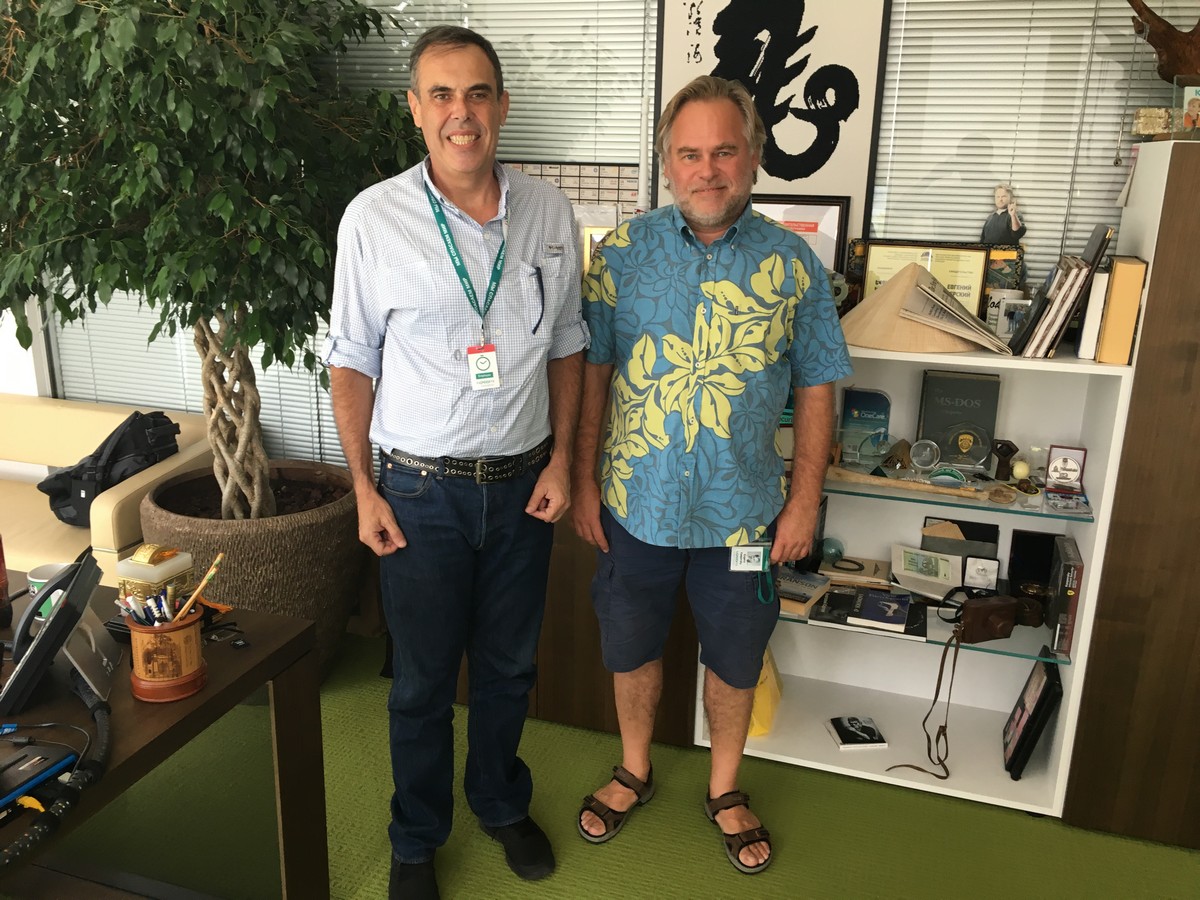
Fast forward to September 28, 2016, and a certain Eugene Kaspersky gives Pope Francis one such Odhner Arithmometer:

https://www.instagram.com/p/BK6AsyGguNu/

Its industrial production officially started in 1890 in Odhner’s Saint Petersburg workshop.

Read on: A bit of subjunctive mood…

Inter-NYET!

Ready? Rant begins – NOW!…

After the Chinese Rail Non-Fail the day before, I could not berliiieeeeeeeve the total fail in a Chinese airport the next day. And not just any old Chinese airport, but the main international airport of China’s capital, no less! The fail was an Internet fail, folks. And the fail was catastrophically, categorically total.

Now, the airport’s immense, beautiful, and just super all round (despite the inevitable Chinese petty tortures/mess-ups), with all its stores, escalators, fountains, sculptures… everything done contemporarily, tastefully and expensively. Everything great except for one thing: no proper Internet! Even mobile Internet ain’t happening, even with a foreign SIM, i.e., with a foreign (not Chinese) number, which doesn’t fall under the Great (Fire)Wall of China. I mean, there is some signal but it’s so weak you might as well not bother.

And I wanted to connect to my blog to write a few ‘on the road’ notes as I like to do, or some ruminations on matters of great importance, plus upload some photos as I like to do, but no – it wasn’t to be. What’s the Chinese for ‘Where’s the Internet, dammit?!’ Please let me know someone. I’ll have it printed on a t-shirt and wear it next time I’m there.

And the ruminations on matters of great importance this week were as follows:

Let’s talk about something that’s so essential to everything that, well, everything – or at least a great many things – wouldn’t exist or be possible. Something so vital that without it life would lose much of its meaning and would become unbearably dull and sad. Something that forms the basis of almost all our modern activities, without which all noble intentions, the reaching of worthy goals, and the securing of a reasonable amount of happiness of various calibers – everything! – would not be possible.

You guessed it yet?

Yep: electricity! What did you think I meant? (Answers > the comments; and keep it clean!)

Just imagine for one minute what would happen if all of a sudden there’d be no more electrical current coming through the sockets – forever! I mean, really: no more, finito, kaput, for ever more!

It would be bad, of course. Real bad. But it wouldn’t be apocalyptic, quite. Life would go on; only – by candlelight and be horse-drawn and with sails!

ATTENTION – QUIZ-QUESTION! PRIZES GUARANTEED FOR THE FIRST RIGHT ANSWER! 

What’s the name of that sci-fi flick where unfriendly invisible aliens that live on electricity land on earth? Who then consume all the electrons in all the cables and even in natural phenomena like thunderstorms? Where at the end the protagonist, by the light of a candle, bemoans how the thunder’s pealing and the rain’s pouring down but there’s no lightning, and probably never will be?

Update/PS: Further to my emotional rant regarding Beijing’s main airport, a few pics for your viewing pleasure (I finally reached a country that provides good Internet; imagine?! So radically technologically progressive!!).

And here’s pic I took from the plane: morning dead calm, and a column of smoke (or steam) rising up from the middle of a cloud.


That’s all for today folks; back tomorrow…

The Biker Boys from Brazil Cross Siberia.

In late July, mentally I was already on vacation in Altai. It was warm, there was the usual seasonal lull in business and a general sense of leisureliness and summer holidays. However, one morning I found a message from our Brazilian partners in my mailbox, and it was completely out of sync with the calm pace of life. At first, I even thought something was wrong: maybe our Brazilian partners had been overexposed to the sun, right on the eve of the Olympic Games? :) Then I read their letter a second time, did some Google searches, and… was blown away.

The bare facts. Two Brazilians who don’t know a single word of Russian decided to visit Russia for the first time in their lives. Over 21 days, they traveled 10,000 kilometers on their motorbikes from St. Petersburg to Vladivostok.

The message explained that the courageous bikers had just flown back from Vladivostok to Moscow, and that they would be spending another couple of days in Moscow before they went home. The message was clear, and I simply couldn’t pass up the chance of meeting the two heroes in person to shake their hands and ask them about their adventure.

Meet Rodrigo Dessaune, an IT businessman by profession, and a hopeless romantic at heart, as well as an extreme long-distance biker.

Image00001

It actually became more than just a meeting, and turned into a full-length ‘interview’, with me asking lots of questions about the Brazilians’ adventures in Siberia. You can read it below – it’s a truly fascinating story!

Read on: Never-ending jetlag…

Rocking the KasBar.

Hi all!

Ahhh – July: always tons getting done in the KL camp before the August lull when lots of us are on vacation – myself included! We’ve had our birthday bash already; there’s all sorts going on corporate-wise, which I’ll not go into here; and here’s the latest July event: the opening – finally! – of our corporate eatery @ our HQ! It’s called BarKas. Yes – the ‘Bar’ of ‘Kaspersky’. We decided on ‘bar‘ as, though it’s more of a restaurant than a bar, it is, in true KL spirit, informal and relaxed just like a bar, only nicer, if you follow me. Also, ‘Restaurant-Kas’ hardly has a ring to it. Plus, there’s the curiosity value in the fact that, in Russian, a ‘barkas’ is… a paddle boat! ‘Perfect’, we thought :).

The ‘beta testing’ of the paddle boat was back in March of this year. And just the other day it finally opened its doors to all and sundry (it’s not a KL-only canteen kinda thing), which I guess includes us – so we decided to give it some ‘alpha testing’…

Read on: First impressions? Nice.

Three questions for physicists.

I did a fair bit of walking in Tanzania on our Kilimanjaro expedition – a whole week’s worth, in fact. That meant I had plenty of time – besides chatting to my companions – to ponder, contemplate and reflect – on all kinds of stuff.

I never once thought about business, but then, not thinking about business was one of the chief aims of the trip. So, naturally, my mind turned to non-work stuff, like life and eternity, nature, man, the universe – and man’s insignificance in it. The latter was reflected upon mostly at night, when I’d look up to the extraordinarily brightly twinkling stars – so much more vivid for being up a mountain; much better than how they look down near sea level.

Like I say – lots of walking time = lots of chatting time, including long chats… with oneself! All sorts of different thoughts arose in my little gray cells, including, for example, the following:

The moon gets three centimeters a year further away from Earth (that’s a scientific fact). At some point Earth will eventually lose its ‘gravitational interest’ in the moon, which will then become one more satellite of the sun. It’s possible that the trajectories of the moon and Earth will intersect again at some distant point in the future, and the moon will again become a satellite of Earth. Or maybe it will collide with Earth? It’s difficult to calculate… but my specific questions (related to this) are easier…

Question No. 1

This will happen earlier than when the sun becomes a much huger, redder and hotter giant than it is now and swallows up the planets near it (Mercury, Venus and Earth) or later? What will happen soonest: the moon will return to Earth, or the sun will eat up this question?

Read on: Questions 2, 2.1 and 3 …

The ‘Masterpiece’ button.

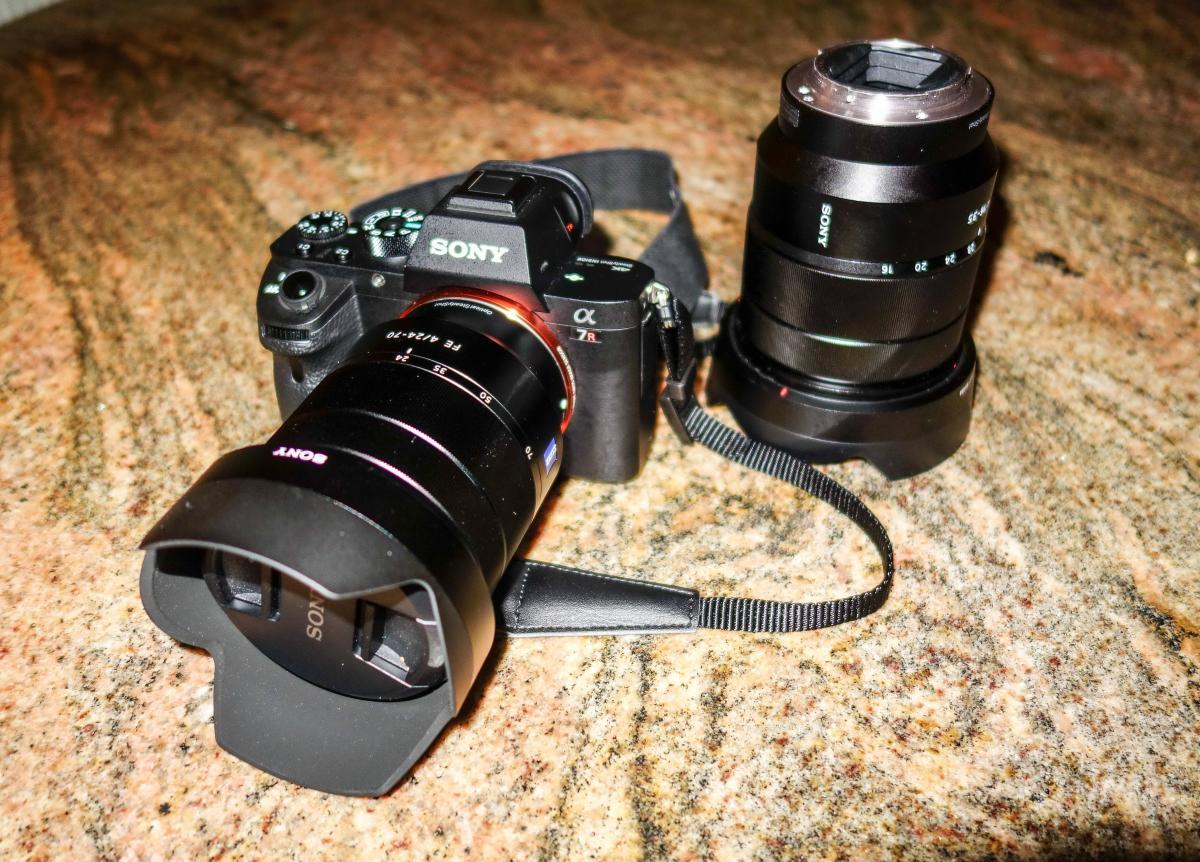
Congratulations to all those who guessed! I now have a Sony-A7 camera [as well as a business, kids and family] hanging round my neck, plus a couple of lenses – a “standard” and a wide angle. Here they are together:

sony-1

So, what can I say about it? As expected, there were no real surprises! The picture quality is superb compared to the same manufacturer’s point-and-shoot (DSC RX100-II). You can see it with the naked eye. But there are still some people with their Lightrooms and other shamanic processing rituals who are wiping their sweaty palms, desperate to show me all kinds of manuals on professional image processing. Yeah, right! I’ve got better things to do than spend hours tinkering with nano-masterpieces, whose total time of public viewing will be less than the time it took to process. No thank you! I need something more straightforward. A couple of runners to move back and forth or up and down a little, a few buttons to press, then cut off what is not necessary – 30 seconds and it’s ready!

But the shots taken with this new camera truly are something else, especially after some minor processing:

https://www.instagram.com/p/–odw9OiTj/

In other words, this camera has the “masterpiece” button that I have long been looking for – unsuccessfully – on other [point-and-shoot] cameras!

I have to say that overall I like it, but there are some questions that still need to be answered. And a few comments.

  1. The camera has a Wi-Fi option meaning you can post your photos to the Internet or upload them to a smartphone or a computer. My first thought was – what about security? Perhaps I should take this smart device to our security experts to be checked? I’d be really interested to know how safe this IoT-device is in terms of the external cyber influences.

// If things carry on like this, we’ll soon have toothpicks with Wi-Fi that immediately send a picture of tooth decay to your dentist.

  1. And what do we need all these extra black wheels for at the front and rear? I moved them around and saw no difference. Or maybe I didn’t turn them hard enough. Perhaps I’ll find the answer later on when I finish reading the manual that takes time. Lot of time. And memory.

Drawbacks:

  1. It’s not pocket-sized! And I doubt I will ever wear jeans with pockets big enough :) // Ideal size for a kangaroo though.
  1. The battery only lasted for 300 photos. What am I supposed to do in Kamchatka?? I’d need to take 10 batteries with me for a week’s travel! Or a power pack for a week? Actually, last time we took solar batteries – they weren’t all that heavy and helped us a lot with the point-and-shoot cameras. Maybe they’ll help with more energy-hungry equipment? I’ll let you know soon.
  1. And by the way, where’s the flash? What do you mean there’s “no flash”? No flash at all?? You’re kidding!? … And so what now? … I guess I’ll have to keep that point-and-shoot camera – with its built-in flash – in my back pocket.


A third (photographic) way.

A few months ago I had a week or so in China visiting areas less-traveled by non-Chinese tourists. It was fantastic – all the more so as it felt ‘exclusive’ and properly ‘going native’. I tried my best to get as much of the experience into memory – my own, that is; but human memories and digital memories these days – you can’t really compare them, especially with one of them fading fast ). So if you can’t beat it – use it. Which is what I did: I used plenty of gigabytes of digital-photographic memory – but not in a super-duper and super-heavy digital SLR, but in my run-of-the-mill pocket Sony – my ‘travel soap dish’, as I call it. I then uploaded it all to my archive for future reference, to help jog my memory in years to come…

Like I say, the China trip was fantastic. But there was so much of the breathtakingly beautiful that it wouldn’t all fit into the viewfinder of my soap dish. I’d long suffered this lack of horsepower what with insisting on traveling light and forgoing the semi-pro mobile photographic studios, but never really minded. But that ‘suffering’ came to a swift end while in China. Specifically, in Jiuzhaigou

…While there, I finally took pity on my fellow traveler, A.Sh., who’d be hauling around with him for the whole trip a very fancy and big and heavy Nikon camera bag. I took a turn to haul it about, giving his shoulder some much-needed respite. But then I got all curious. I started prodding it and twisting dials and lenses and even pressing the ‘shoot’ button. There was so much awesome scenery everywhere, it was hard not to. Then, back at the hotel that evening I looked at the results on the laptop. And that was when I had my eureka moment. I took one look at those semi-pro-looking pics, couldn’t believe I’d taken them, and decided there and then: that’s it; soap dish days are over. It’s time to upgrade/overhaul/paradigm-shift/tectonic-shift! No matter how much heavier and more cumbersome: it’s worth it!

mylnica-1

Read on: No more soap dishes!…

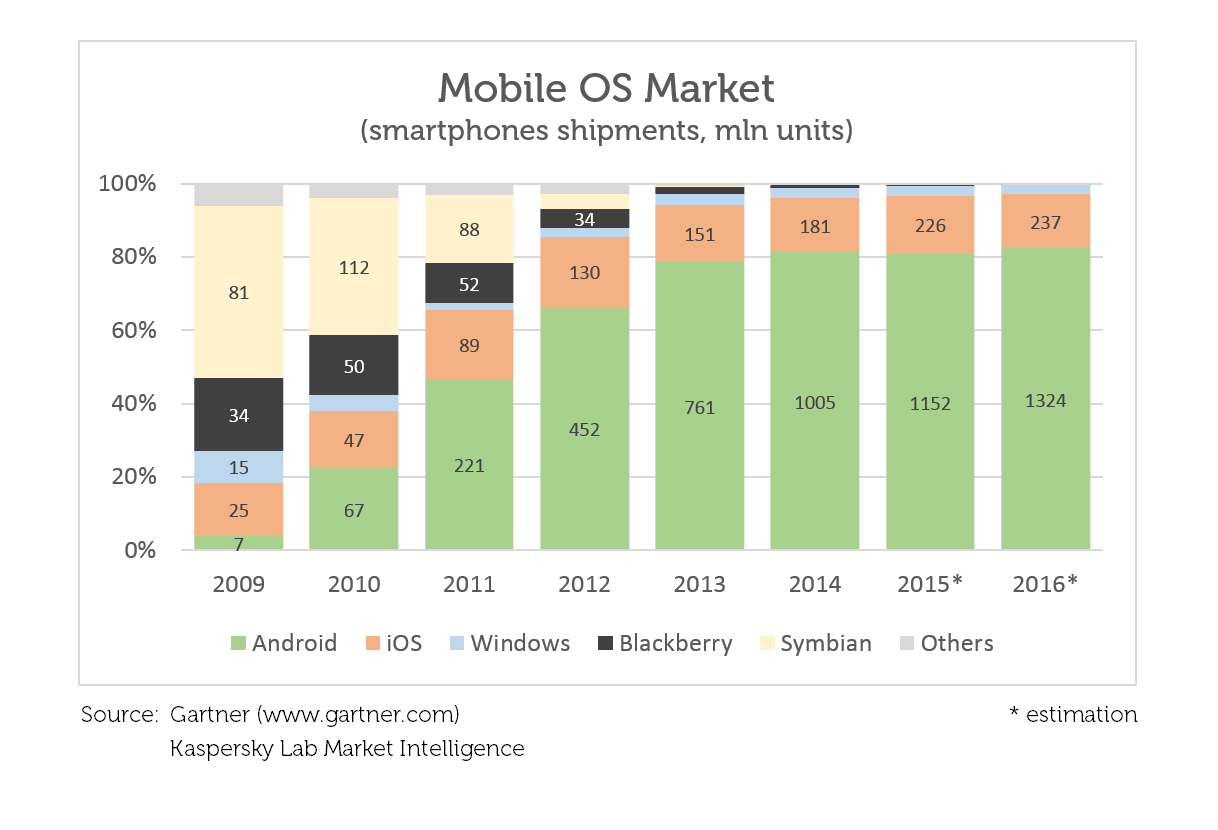
Mobile OS market: 2015

A long, long time ago – in December 2010 – I had a bet with a friend about the future of the smartphone market.

Read that again: in December 2010. That is, exactly five years ago!

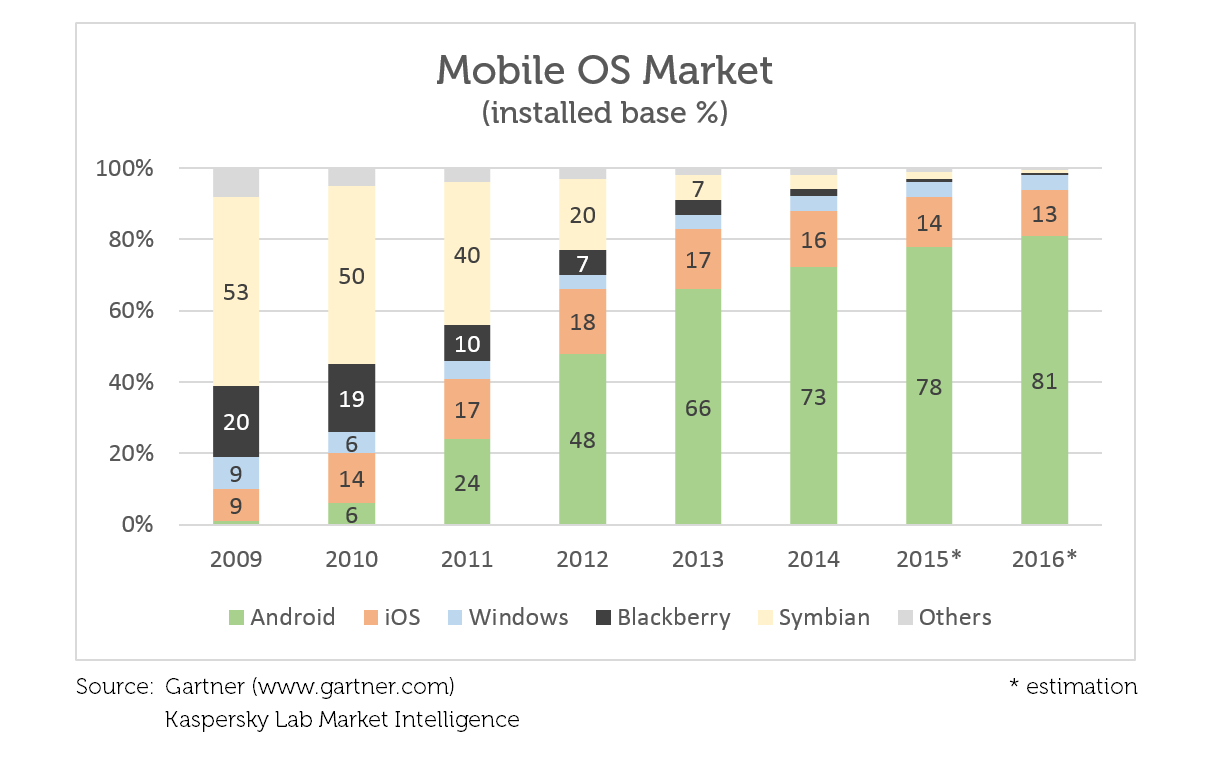
Back then, the ‘real’ smartphone segment was dominated by Apple, while green gremlin Android was only getting a peak in. My mate assured me that things would mostly stay that way, with Google-Android never being able to get anywhere near iOS. But I reckoned that things would be just the opposite in five years’ time, with the market being divvied up so:

80% – Android;
10% – iOS;
10% – all other mobile OS.

My reasoning was displayed here half a decade ago. Have a look! There’s only about one and a half pages of my text there.

Soooo, five years later……. And it looks like……. I got it right!

mos_ib_en

mos_ship_en

PS. No one tried to answer the question of my previous post? I repeat: how can you distinguish day from night at the North or South Pole when the season of Northern Lights (or ‘Southern Lights’) is in full swing, i.e., when night is as light as day?

For those who come up with the quickest, wittiest and most accurate answers – prizes await! Geeee. All these prizes and presents. It’s almost as if it’s nearly Christmastime :).

And in sports news – Misha is the chess champion!

Oh yes, the boy’s done good ace! Mikhail Antipov, our chess champ, has won the World U20 Championship 2015!

How the boy’s come on – from the modest boy-next-door, to the widely known (at least in the world chess clique:) world-beating champion with major trophies on the mantelpiece already! What’s especially pleasant about this news? Actually, all of it!…

First – chess is a very useful and proper pastime for training the brain. And if it grows into being a professional undertaking with worldwide recognition – ah, that’s the second already. And third, it’s nice to know we had a hand in seeing Misha make it to the top, after supporting him since his early days in the game.

WJCC2015-Emelianova-r13-37

Read on: