Tag Archives: cyber criminal

Cybernews from the dark side: June 30, 2014

Stock market hacks for microsecond delays.

Cyber-swindling gets everywhere. Even the stock market. First, a bit of history…

The profession of stockbroker was once not only respected and honorable, but also extremely tough. Dealers in stocks and shares once toiled away on the packed floors of stock exchanges and worked silly hours a week, stressed to the limit by relentless high pressure decisions all day (and night). They bought and sold securities, stocks, bonds, derivatives, or whatever they’re called, always needing to do so at just the right moment while riding the waves of exchange rates and prices, all the while edging nearer and nearer to serious heart conditions or some other burn-out caused illness. Other times they simply jumped out of windows to bring a swift end to it all. In short – hardly the world’s best job.

Anyway, all that was long ago. All that hard manual labor has been replaced by automation. Now thinking hard, stressing and sweating aren’t needed: a large proportion of the work today is carried out by robots – special programs that automatically determine the very best moments to buy or sell. In other words, the profession of stockbroker has in large part been boiled down to the training of bots. And to these bots reaction times – to the microsecond – are vital to take advantage of this or that market swing. So speed literally depends on the quality of an Internet connection to the electronic stock exchange. That is, the nearer a robot is physically located to the exchange, the higher its chances of being the first with a bid. And vice versa – robots on the periphery will always be outsiders, just as will those not using the very latest progressive algorithms.

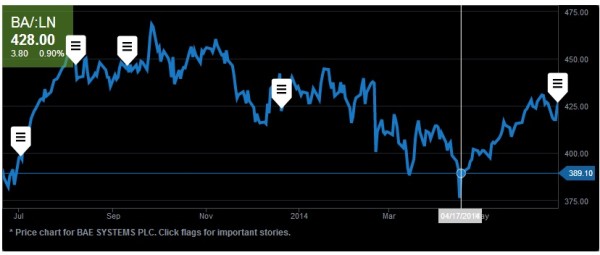
These critical reaction times were recently tampered with by unknown cyber-assailants. A hedge fund’s system was infected with malware to delay trading ability by a few hundred microseconds – which can – and probably did – make all the difference between clinching deals and losing them.

bae-600x255

Read on: Your password for a Twix?…

10 years since the first smartphone malware – to the day.

On June 15, 2004, at precisely 19:17 Moscow time something happened that started a new era in computer security. We discovered the first malware created for smartphones.

It was Cabir, which was infecting Symbian-powered Nokia devices by spreading via unsecured Bluetooth connections. With its discovery the world learned that there was now malware not just for computers – which everyone already knew too well about (save for the odd hermit or monk) – but also for smartphones. Yes, many were scratching their heads at first – “viruses infecting my phone? Yeah, pull the other leg” – but the simple truth of the matter did finally sink in sooner (= months) or later (= years a decade!) for most people (some still aren’t aware). Meantime, our analysts made it into the history books!

Why did we christen this malware Cabir? Why was a special screened secure room created at our Moscow HQ? And how did Cabir end up in the pocket of an F-Secure employee? These and other questions were recently put to Aleks Gostev, our chief security expert, in a interview for our Intranet, which I thought I’d share with you here; might as well have it from the horse’s woodpecker’s mouth…

Incidentally, the story started really running when we used these two devices to analyze the malware:

The legendary Symbian-powered Nokia phones we used to analyze Cabir

…but more about those below…

Read on: An unusual file n the inbox…

Cybernews from the dark side – June 4, 2014.

True to my word, herewith, the second installment of my new weekly (or so) series, ‘dark news from the cyber-side’, or something like that…

Today the main topic will be about the security of critical infrastructure; in particular, about the problems and dangers to be on the watch for regarding it. Things like attacks on manufacturing & nuclear installations, transportation, power grid and other industrial control systems (ICS).

Actually, it’s not quite ‘news’ here, just kinda news – from last week: fortunately critical infrastructure security issues don’t crop up on a weekly basis – at least, not the really juicy bits worthy of a mention. But then, the reason for that is that probably that most issues are kept secret (understandable, but worrying all the same) or simply no one is aware of them (attacks can be carried out on the quiet – even more worrying).

So, below, a collection of curious facts to demonstrate the current situation and trends as regards critical infrastructure security issues, and pointers to what needs to be done in face of the corresponding threats.

Turns out there are plenty of reasons to be bowled over by critical infrastructure issues…

If ICS is connected to the Internet, it comes with an almost 100% guarantee of its being hacked on the first day

The motto of engineers who make and install ICS  is ‘ensure stable, constant operation, and leave the heck alone!’ So if a vulnerability in the controller is found through which a hacker can seize control of the system, or the system is connected to the Internet, or the password is actually, really, seriously… 12345678 – they don’t care! They only care about the system still running constantly and smoothly and at the same temperature!

After all, patching or some other interference can and does cause systems to stop working for a time, and this is just anathema to ICS engineers. Yep, that’s still today just the way it is with critical infrastructure – no seeing the gray between the black and the white. Or is it having heads firmly stuck in the sand?

In September last year we set up a honeypot, which we connected to the Internet and pretended was an industrial system on duty. The result? In one month it was successfully breached 422 times, and several times the cyber-baddies got as far as the Programmable Logical Controllers (PLC) inside, with one bright spark even reprogramming them (like Stuxnet). What our honeypot experiment showed was that if ICS is connected to the Internet, that comes with an almost 100% guarantee of its being hacked on the first day. And what can be done with hacked ICS… yes, it’s fairly OMG. Like a Hollywood action movie script. And ICS comes in many different shapes and sizes. For example, the following:

Nuclear malware

Mondju nuclear reactorSource

Read on: absence of light will only be the result of burned out bulbs and nothing else…

Cybernews from the dark side – May 26, 2014

Greetings droogs!

It seems ages since I’ve touched upon a cyber-maliciousness topic on these here pages – what’s hot and what’s not, what’s in and out, and all that… You might even think we’re twiddling our thumbs here seeing as I stay shtum on topics relating to our raison d’être…

Well just let me reassure you that we are on top of EVERYTHING going on in the cyber-jungle; it’s just that we publish all the detailed information we have on dedicated techy news resources.

The only problem with that is very few folks actually read them! Maybe that’s understandable: the detail can get tiresome – especially to non-tech-heads. Not that that’s a reason not to publish it – far from it. However here on this blog, I don’t bog the reader down with too much tech. I just give you the most oddly curious, amusing and entertaining morsels of cybernews from around the world.

Sooo, what was curiously odd, entertaining and bizarre last week?…


“He hit me!” “He started it!”

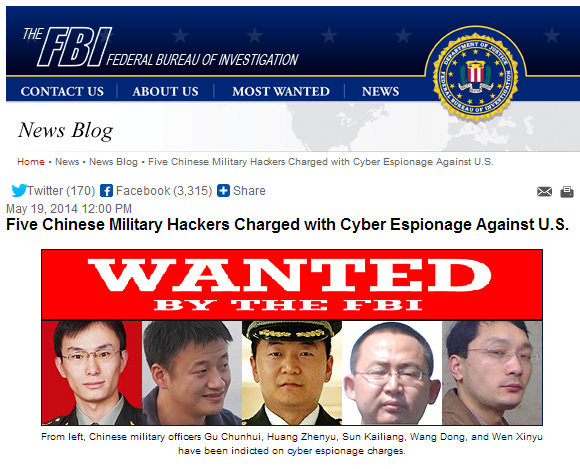
The sparring between the USA and China about cyber-espionage has taken a new turn…

This time the Americans took their swipe with photographs and names of ‘guilty’ individuals: five Chinese military specialists have ended up on the latest classic Wild West-inspired FBI ‘Wanted’ poster for allegedly breaking into networks of US companies and stealing secrets.

Cyber security news of the week

Read on: An example of some seriously perplexing cyber-alchemy…

Cybercriminals beware: CYBERPOL is coming…

Who are these folks? Maybe the color of (most of) the ties should give you a clue…

INTERPOL - Global Center for InnovationAnd I was trying to blend in…

…For most of you they’ll never have anything to do with you, and you’ll have nothing to do with them. You hope.

But for those who make up the Internet minority who steal money from online banks, clog up e-mail with spam, hack websites, produce credit cards with stolen numbers, etc. – maybe they should take note of this modest crowd. Because these here suits and ties have a particular, burning… obsessive professional interest in that same Internet minority.

Read on: so, who are these people?…

K-LOVE & KISSES 2014: REASONS TO BE CHEERFUL, PART 3.

“The person needs to be brought round to the idea that he has to part with his money. He needs to be morally disarmed, and his proprietary instincts need to be stifled.”

No, not Don Draper; this is a quote of Ostap Bender, a classic fictional hero from 1930s Russian literature. And no, there’s no relation to the other famous Bender!

Thus, it would appear that, curiously, Mr. Bender knew a thing or two about capitalism, despite being from a Communist country. Hmmm…

Anyway, what he knew is that it’s sometimes possible to make folks part with their hard-earned shekels if they are manipulated the right way – the folks, that is.

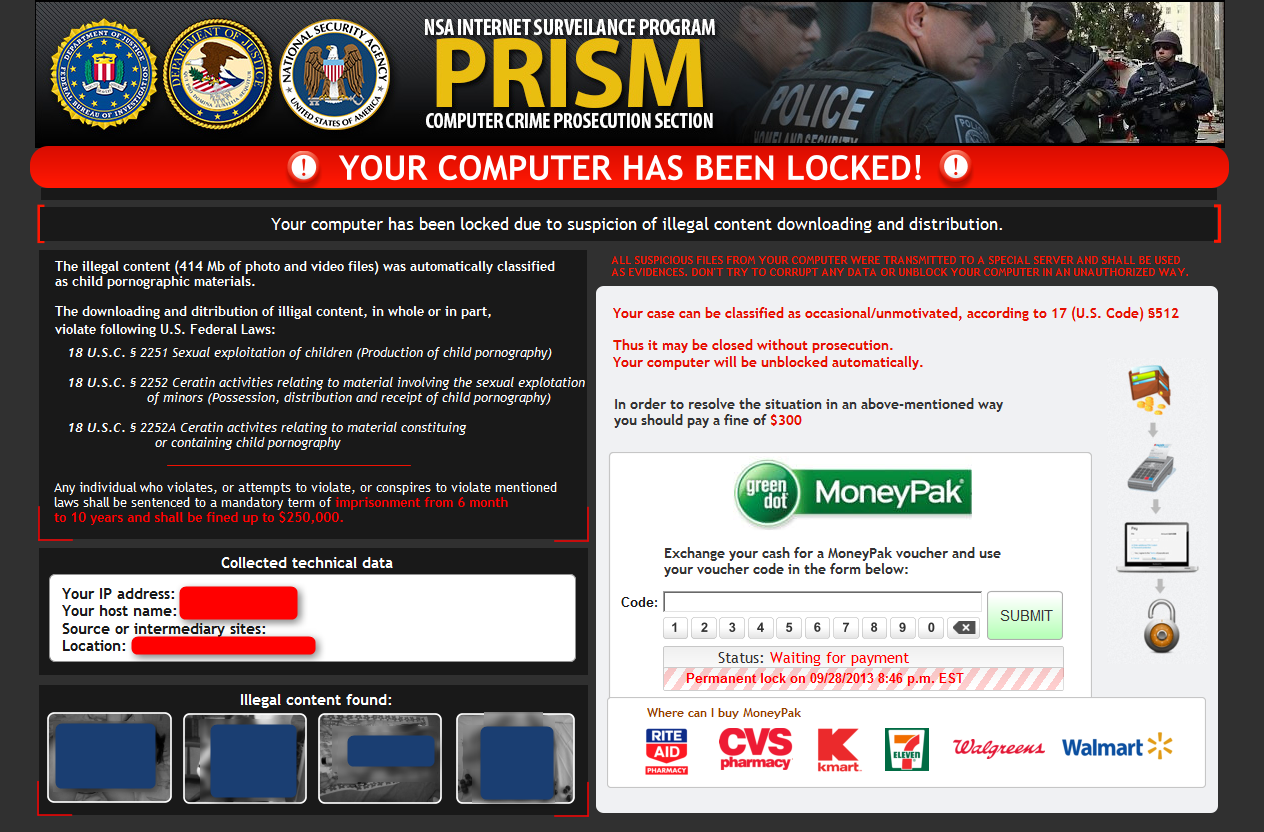
Fast-forward to today… and we find this kind of manipulation alive and well – in a modern, hi-tech, cyber kinda way: Today, folks gladly hand over their Benjamins to the crims behind blockers, aka ransomware, an especially sneaky form of computer malevolence. But have no fear, KL users: in the new version of KIS, we’ve got a nice surprise waiting for the blocking blockheads and their blockers.

Ransomware criminal market turnover made up more than $15 million, while the number of victims reached the tens of millions

The principle and tech behind blockers/ransomware are rather simple.

Using one of the various means available (for example, via a software vulnerability), a malicious program is sneaked into computer, which then displays an amusing (not) photo with scary (not – with KIS:) – text, and blocks the desktop and all other programs’ windows.

Unblocking is only possible (well, was possible – see below) by entering a unique code, which of course you can only get from the cyber-tricksters who infected the comp in the first place, and of course – for a fee, through premium SMS numbers or online payment systems. Until you pay the ransom, the comp remains kidnapped – no matter what you do (including Ctrl+Alt+Del), and no matter what programs you try to run (including antivirus); all you see is something like this:

ransomware1

The rise, the decline & the return of ransomware…

Kings of Lyon.

A little while back we had the General Secretary of Interpol, Ronald Noble, visit us in Moscow. He really is quite a guy. He’s been awarded the French Legion of Honor, is a professor of the New York University School of Law, and – surprise, surprise! – is an honorary professor of the Urals State Legal Academy (if you believe the Russian Wikipedia page on him:). Anyway, it’s now my turn to pay him a combined business and social call…

eugene-kaspersky-interpol1

Lyon in France houses the head office of Interpol. When I asked “Can I take photographs?”, I was delighted by the answer, “whatever and wherever you like”.

More: So I took some photographs…

INTERPOL drop inter KL.

A few days ago our first – ah, no, second! – ever A-list guests dropped by our new office to see us. Ronald Noble, the Secretary General of INTERPOL, and our good acquaintance Noboru Nakatani, the head of INTERPOL’s new cyber division in Singapore, came to see us on a friendly visit that resulted in the official announcement of our cooperation to more effectively fight cybercrime on a global level.

interpol-kaspersky-team-fight-cybercrime-international-level1

More: Calling all cyberswine – watch out!…

Catching the Phishes.

I’m not completely sure why, but  somehow since the invention of the Internet, there has always existed a stereotypical attitude towards all things WWW. That attitude sees the net as little more than a toy, while the viruses that come with it are put down to mere playing about at best, and just hooliganism at worst. However, the reality is quite something else – especially lately.

Remember Cascade and other similar viruses? Ah, so naïve and innocent compared to what was to come… Fast forward a couple of decades and the bad guys started stealing data, Trojanizing computers for zombie networks to perform distributed attacks, and milking bank accounts. And today we’ve arrived at attacks on industrial, infrastructural and military systems. Some toy!

We need to get away from such a stereotype ASAP. Faulty impressions give cybercrime a romantic aura, which in turn attracts the younger generations of would-be cybergeeks-come-cybercriminals – who can’t seem to grasp the seriousness of their “fun” or understand how many years they could face in jail.

Then there’s another stereotype: that computer crime pays, and the perpetrators don’t get caught. Romanticism! Ok, it’s true that several years ago in many countries computer crime was in fact not all that often prosecuted; however, now that situation has changed: the law enforcement bodies have both the experience and know-how required, have made great strides in terms of cyber-criminalistics (cyber-CSI stuff), and have established good working relations with professionals, all leading them to now being able to solve one hi-tech crime after another.

We are always ready to assist national and international law enforcement agencies if they request it. I think the development of such cooperation is crucial for the successful fight against cybercrime – as security companies are the ones that possess the necessary knowledge.

Now, let me give you an illustrative example of how it works in Russia.

More: Catching the phishes …

Worse than Cheese: Scary Scenarios Causing Nightmares Now – the Five Main Issues of IT Security.

I recently found myself wondering how many interviews with the press I do every month. Of course the totals fairly helter skelter between months, but in the busier periods the number can get anywhere up to 70! And that’s only spoken interviews, i.e., those done in person or over the phone. If I were to also include e-mail interviews – the number would be just silly.

But I don’t complain. In fact just the opposite – I love interviews! Which reminds me of Richard Branson and his simple rule about interviews: “If CNN rings me up and wants to do an interview with me, I’ll drop everything to do it.” I also follow this rule – to the letter – and not without good reason.

Most interviews are what you’d expect. I get asked lots of questions, I answer them as best I can, and that’s about it.

But in a very few rare instances I get interviewed by a really well read-up journalist, meticulous to the point of hair-splitting, who not only knows all about me and KL and what we do, but also all about the particular narrow topic the interview’s about. By the end of the allotted hour I’m exhausted, the mind’s pretty much frazzled, and I feel like my very soul’s been extracted together with my long-winded answers to the sophisticated questions.

These are the trickiest and most trying kinds of interviews, but also the most useful. Why? Because during such intense sessions the gray matter inside the skull shifts up a gear or three and really gets to work, thinking in new ways and approaching familiar topics from fresh standpoints – to such an extent that after the end of the interview the momentum keeps the ideas coming, leading to all sorts of new insights. All really quite fascinating how creative cognition comes about. And all kicked-off by super-sharp reporters doing their job masterfully. Respect due. And a thank you!

Curiously, what unites such “special” interviews with regular ones is an inevitable question about the most pressing IT Security issues today – something like: “What keeps you up at night (in terms of IT Security hazards)?”! And I don’t get asked this all the time just by journalists in interviews. The question pops up at practically every IT conference I speak at.

And so: as promised earlier, here I’m presenting my List of the Five Main Issues Facing IT Security, in the broad sense of the term.

I should say straight away that I don’t have prescriptions for solving all five issues. The aim of this post is more to identify the problems, let you start to muse on them, and hopefully draw you into the fold of their ongoing discussion by raising your interest, empathy and/or sympathy!

Right, here’s my list:

  1. Privacy
  2. Internet Passports
  3. Social Networks
  4. Cybercrime
  5. Cyberwarfare

More: getting into details …